
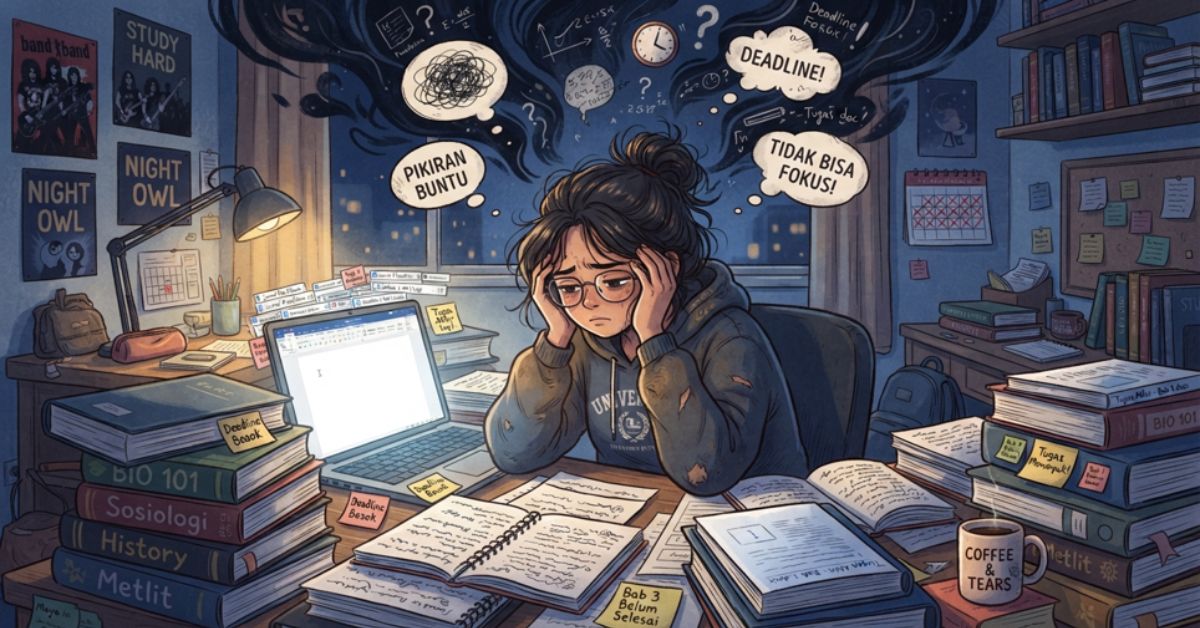
When the Pages Are Open but the Mind Goes Blank: Recognizing Academic Burnout Amid a Mountain of College Assignments
By: Muhammad Afiq Izzan Budiawan
A document page or reading material is already open on a laptop screen or study desk, the cursor blinks slowly, yet even putting together a single paragraph feels overwhelming. At the Faculty of Adab and Humanities, Syarif Hidayatullah State Islamic University Jakarta, situations like this often arise in the middle or toward the end of the semester, when academic responsibilities come one after another. There may be a paper draft with footnotes that still need to be organized, Arabic texts whose sentence structures and translations require further analysis, class presentation materials, book reviews, and group assignments with deadlines falling close together.
People are often quick to label this kind of mental block as laziness. However, when academic workloads and daily responsibilities pile up without sufficient recovery time, the problem is not simply a lack of motivation. This condition is more accurately described as burnout: mental, emotional, and physical exhaustion caused by prolonged pressure, eventually depleting one's ability to think and concentrate.
Distinguishing Laziness from Burnout in Academic Life
Laziness and burnout need to be distinguished so that we do not judge ourselves too quickly. Laziness usually occurs when motivation is low or someone is reluctant to get started, without being subjected to prolonged and excessive pressure. When feeling lazy, people generally remain relatively relaxed during their free time and postpone their work simply because they are not interested or do not feel the need to start immediately.
Burnout is different. It occurs when mental capacity is repeatedly pushed beyond reasonable limits without adequate time for recovery. The mind feels sluggish even though we are fully aware that the assignment is important and its deadline is approaching. The difference also becomes apparent during free time. Rather than feeling relieved, students experiencing burnout often continue to feel exhausted, anxious, or guilty because they still have unfinished responsibilities. Their emotions may also become more easily triggered, emotionally numb, or less enthusiastic about activities they would normally enjoy.
Amid academic demands that require accuracy and attention to detail, treating both conditions as mere laziness does not solve the problem. Students who believe they are simply lazy often blame themselves excessively and respond by forcing themselves to study for unreasonable lengths of time. If the underlying cause is accumulated mental exhaustion, such pressure only widens the gap between the desire to complete assignments and the brain's actual ability to process information.
Signs of Mental Exhaustion That Often Go Unnoticed
Mental exhaustion rarely appears suddenly overnight. It usually develops through early warning signs that are often dismissed as insignificant until the learning process becomes seriously disrupted. A decline in comprehension is among the most common symptoms. A paragraph of text or a reference quotation may be read repeatedly without being properly understood, while deciding the order of tasks or making even minor decisions takes longer than usual.
Over time, sensitivity toward the learning process and academic achievements may also weaken. Reading materials, classroom discussions, and the careful construction of arguments that were once taken seriously may begin to feel dull and meaningless. Hours may be spent handling various responsibilities, yet there is a persistent feeling that nothing has truly been completed. At a certain point, the exhaustion may also affect the body, causing a heavy head, stiff shoulders and neck, disrupted sleep patterns, or changes in appetite.
These signs often emerge when assignment deadlines are approaching. Initially, daytime sleepiness or reluctance to open a document may easily be attributed to hot weather, tiring commutes, or a lack of coffee. However, when these patterns continue for days or even weeks without sufficient breaks, seemingly minor issues gradually accumulate and become significant obstacles to concentration and sustained thinking.
Common Triggers That Students Often Overlook
In addition to overlapping academic deadlines, student burnout is often triggered by responsibilities outside the classroom. Many students actively participate in student organizations, campus event committees, extracurricular discussion forums, while simultaneously managing part-time jobs or family responsibilities. When all these activities take place simultaneously without clear boundaries, daily schedules become packed from morning until night, leaving little room to pause and catch one's breath.
The pressure to always appear capable can also add to the burden. Comparing oneself with the progress of fellow students, worrying about falling behind academically, and spending time staring at digital screens late into the night keep the mind constantly alert. Time that should be devoted to recovery is instead consumed by anxiety over the next task waiting to be completed.
The Illusion of Productivity: Staring at a Screen for Hours Without Making Progress
There is a particular phase when mental energy begins to run low: feeling busy throughout the day without making any meaningful progress. Someone may sit in front of a laptop for three hours, switch from one tab to another, make only minor adjustments to spacing or punctuation, and eventually feel as though the entire day has passed without accomplishing anything. From the outside, it may look like hard work, but in reality, the brain is overwhelmed by the difficulty of deciding what to do next.
In academic disciplines that require extensive reading, textual analysis, and repeated argument development, the trap of perfectionism often makes this situation worse. After writing just a few sentences, the mind immediately demands perfection, complete with appropriate references and the most precise wording possible. As a result, fingers often stop typing before the main ideas have had a chance to flow fully onto the page.
Subtle Impacts on Group Relationships and Academic Motivation
Burnout does not affect only individual assignments; its consequences are often felt in group projects as well. When mental energy runs low, messages in discussion groups can become irritating, brief replies may easily be misinterpreted, and previously smooth task distributions can begin to stall. Students who are usually active in contributing ideas may suddenly choose to remain silent because they no longer have the energy to debate or reorganize plans.
Something similar often happens to the enthusiasm for reading and discussions that students once genuinely enjoyed. Books that were previously read with curiosity gradually begin to feel like administrative obligations that simply need to be completed. If this condition continues unchecked, exhaustion can become attached to the entire university experience, making every course feel like nothing more than a checklist of tasks that must be completed.
How to Manage Academic Workloads When Mental Energy Begins to Decline
Facing a pile of assignments while mentally exhausted by forcing oneself to stay up late or increase working hours often makes the mind even more overwhelmed. A more reasonable first step is to take a genuine break from screens and reading materials. Getting up from the study desk, taking a light walk, breathing slowly, or drinking a glass of water can help reduce tension before returning to the document.
Once the mind feels a little clearer, reorganize priorities realistically. Write down all outstanding responsibilities on paper so that they no longer keep circulating in your mind, then choose one to three of the most urgent tasks that can realistically be completed that day. When energy is running low, making progress is far more helpful than demanding perfection from the beginning. Creating a rough outline or working on the essential sections first is much more effective than getting stuck for too long on minor details.
If there are group assignments, accumulated revisions, or conflicting schedules, communicate openly from the beginning rather than keeping everything to yourself until the final deadline approaches. Adjusting the division of responsibilities or revising the work plan can help reduce the collective burden. Beyond academic matters, protecting time for rest is equally important. Getting enough sleep, taking a temporary break from anxiety-inducing digital devices, and allowing yourself to rest without setting specific targets can help maintain the mental endurance needed to get through the end of the semester.
Recognizing the early signs of burnout is not a sign of weakness among university students. Rather, it is a reasonable way to maintain mental clarity so that academic life can be completed in a healthy and sustainable manner. By honestly acknowledging personal limits, assignments can be managed one by one without sacrificing mental health throughout the university journey.