
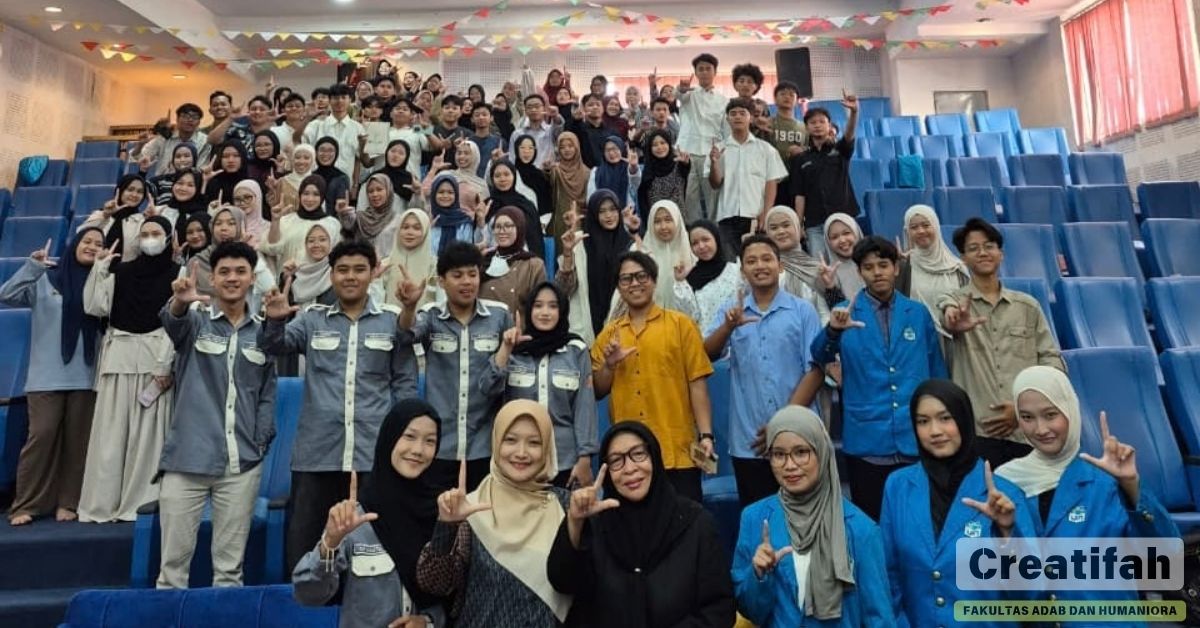
Translation Study Program of FAH UIN Jakarta Holds International Translation Day 2026: Discussing the Value of Human Translation in the AI Era
Jakarta, September 30, 2026, FAH Online – The Translation Study Program, Faculty of Adab and Humanities (FAH), UIN Syarif Hidayatullah Jakarta, held International Translation Day (ITD) 2026 on Wednesday, September 30, 2026. The event began at 8:00 a.m. Western Indonesia Time (WIB) and continued until completion at the 5th-floor Theater of FAH UIN Syarif Hidayatullah Jakarta.
Carrying the theme “The Value of Human Translation: Why Nuance and Context Still Matter in the AI Era & Practical Training in Post-Editing Modern Translation Output,” the event provided an opportunity for Translation students to reconsider the role of translators amid the rapid development of artificial intelligence (AI).
The event was opened by the Head of the Translation Study Program, Prof. Dr. Darsita S., S.S., M.Hum. The main session was delivered by Ida Nurjannah, an outstanding student of the Translation Study Program and a senior student, who shared her knowledge and experience regarding developments in the translation industry in the AI era.
In her presentation, Ida Nurjannah explained that AI offers advantages in terms of speed, language-pattern recognition, and large-scale text processing. However, human translators continue to play an important role in capturing nuance, context, judgment, and the responsibility involved in producing a translation.
The question, “AI can translate. But can AI understand?” became one of the key ideas discussed during the session. It encouraged students not to view AI merely as a threat, but also to understand how technology can be utilized as part of the translation workflow.
The session also explored the changing role of translators as AI technology continues to develop. AI can help accelerate the translation process, provide word choices, gather references, and reduce technical workloads. At the same time, translators remain responsible for reviewing, filtering, and selecting appropriate equivalents according to context, while maintaining the quality and reliability of the translated work.
The event emphasized that translation is not merely a process of replacing words. Translators do not simply produce a number of words in the target language; they convey meaning that can be trusted. The more complex the translation task, the greater the need for human judgment, particularly when dealing with context, culture, and communication objectives.
Therefore, Translation students were encouraged to develop the mindset that they do not necessarily have to compete with AI, but rather learn how to work alongside it. Today's translators are expected to be capable of guiding and reviewing technological outputs while maintaining professional responsibility for the meaning conveyed.
In addition to discussing the value of human translation, ITD 2026 encouraged students to prepare competencies relevant to the modern translation industry, including mastery of language pairs, portfolio development, specialization in specific fields, and an understanding of AI, computer-assisted translation (CAT), and Machine Translation Post-Editing (MTPE).
Through this event, the Translation Study Program of FAH UIN Syarif Hidayatullah Jakarta emphasized the importance of preparing students to face technological developments without losing the fundamental values of the translation profession. Technology can assist in producing translations, but translators remain responsible for the meaning, context, and trust entrusted to their work.
International Translation Day 2026 served as a reminder that technological advancement needs to be accompanied by the strengthening of human competencies. The ability to utilize technology while maintaining accuracy, responsibility, and sensitivity to meaning is an essential part of a translator's competence in the AI era.
Writer: Diana Cantika