
Three FAH Autonomous Organizations Welcome New Faces on the Leadership Stage
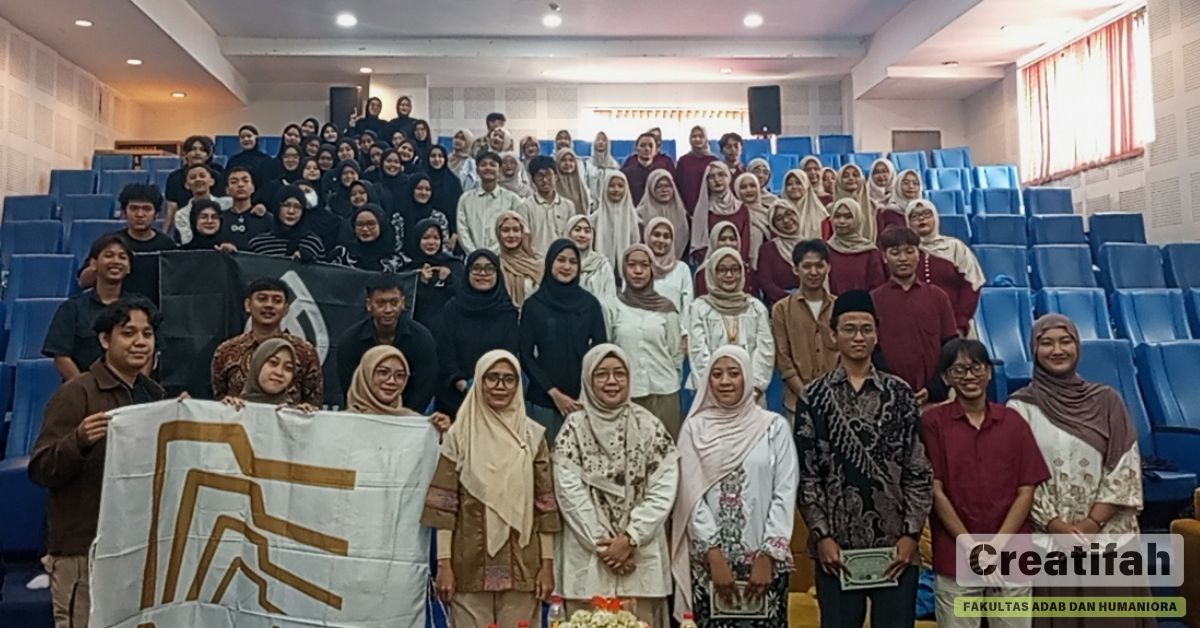
Abdul Ghani Theater Room, FAH News Online – Today, Wednesday, September 9, 2026, the inauguration of the new executive boards for the 2026 period of three Autonomous Organizations within the Faculty of Adab and Humanities (FAH) was held at the Abdul Ghani Theater Room, Faculty of Adab and Humanities (FAH). The three Autonomous Organizations are Pustakawan Praktikum (PUSTIKUM), Pusat Studi Kearsipan (PUSAKA), and Kesenian FAH (ARTEFAH).
The event was attended by Vice Dean III, Prof. Usep Abdul Matin, M.A., M.A., Ph.D., along with PUSAKA advisors, Hikmah Irfaniah, M.Hum., and Fahma Rianti, M.Hum.
“One of the core elements of an organization is sustainability, because sustainability is what keeps an organization alive and enables it to continue developing from one generation to the next,” said Vice Dean III for Student Affairs and Alumni, Prof. Usep Abdul Matin, M.A., M.A., Ph.D., in his remarks. He also encouraged students to remain active and not postpone opportunities for personal and organizational development.
The event continued with presentations on the history and activity reports of each Autonomous Organization. The history and activities of PUSTIKUM were presented by Nayla Rizki, the newly elected Chairperson of PUSTIKUM. In her presentation, Nayla expressed her hope that, as the new chairperson, she would be able to further improve and develop PUSTIKUM.
The history and activity report of PUSAKA was then presented by Bagas Wicaksono, the newly elected Chairperson of PUSAKA, followed by Mas Mochamad Ikhsan Adzani, the newly elected Chairperson of ARTEFAH. In his remarks, Ikhsan expressed his sincere gratitude to the previous executive board for its contributions and dedication in helping ARTEFAH grow and develop from year to year.
Through this event, the new executive boards of PUSTIKUM, PUSAKA, and ARTEFAH for the 2026 period were officially inaugurated and are ready to carry out their respective work programs under the auspices of the Faculty of Adab and Humanities, UIN Syarif Hidayatullah Jakarta.
Writer: Dewi Nurfajriyah