The Importance of Preserving Literary Archives as National Identity in the PUSAKA National Seminar 2026
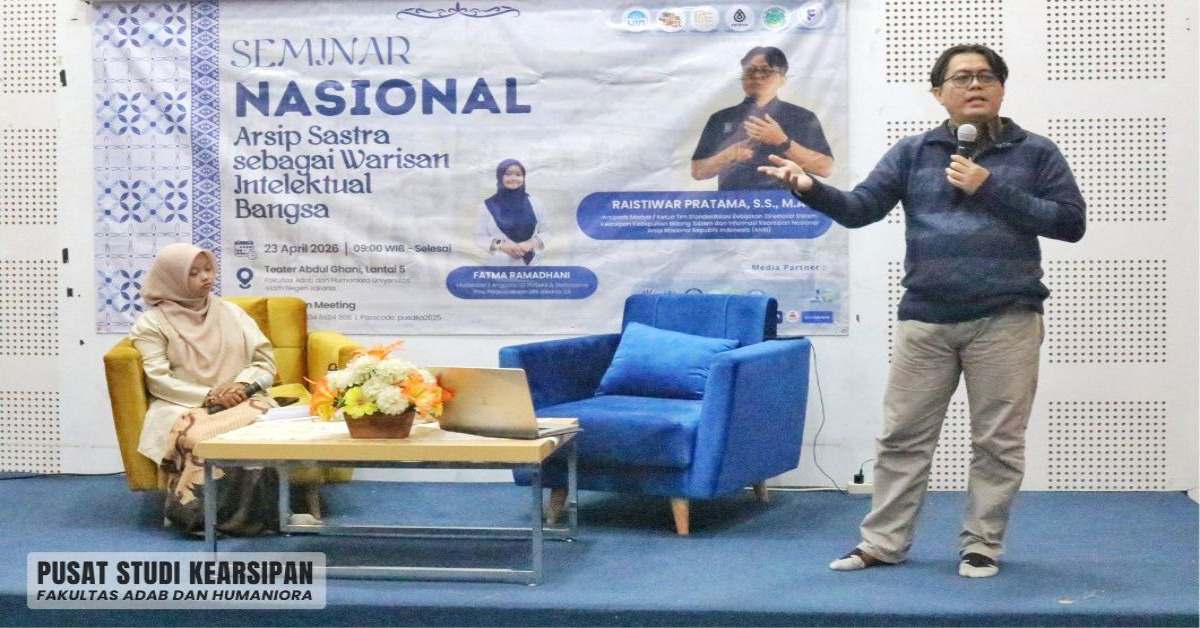
South Tangerang, FAH Online News – On Thursday, April 23, 2026, the Autonomous Institution of the Archival Studies Center (PUSAKA), Faculty of Adab and Humanities, UIN Syarif Hidayatullah Jakarta, successfully held the PUSAKA National Seminar 2026 at the Abdul Ghani Theater, 5th Floor. The event, which was also broadcast via a virtual Zoom Meeting room, raised a profound theme: “Literary Archives as the Nation’s Intellectual Heritage.”
The activity began with participant registration at 08:30 WIB, followed by the official opening by the master of ceremonies and the singing of the Indonesian national anthem Indonesia Raya and the UIN Hymn.
A solemn atmosphere filled the room as faculty leaders were present, including the Dean of the Faculty of Adab and Humanities, Dr. Ade Abdul Hak, S.Ag., S.S., M.Hum., CIQnR, along with the Vice Deans. The presence of Raistiwar Pratama, S.S., B.A., M.A., as the main speaker from the National Archives of the Republic of Indonesia (ANRI), further enriched the academic value of the event.
In her remarks, the Chairperson of PUSAKA for the 2025/2026 period, Diva Nazva Savitri, expressed gratitude to all parties who supported the event. She highlighted the speaker’s perspective on the phenomenon of archival fiction in Indonesia, where archives are no longer merely seen as rigid collections of past documents. According to her, literary archives are part of memory, identity, and a reflection of the relationship between knowledge and power in society. She emphasized that through literary works, people can better understand archival practices and the profession of archivists.
In the main session, Raistiwar Pratama delivered a presentation titled “Archives, Fiction, and Imagination: From Description to Context.” He invited participants to view archives beyond static physical entities. Referring to various modern archival theories, he emphasized that archives are intangible cultural expressions that must respond to post-colonial and international challenges. He categorized archival fiction into four main types: historicization, recognition, surveillance, and archiving.
Through an in-depth analysis of iconic literary works such as Max Havelaar, the Buru Quartet by Pramoedya Ananta Toer, and Ronggeng Dukuh Paruk, he demonstrated how literature records archival practices often overlooked in official records. He also explained the various relationships between archives and literature, from pre-publication archival processes to reinterpreting archives as forms of representation and perspective. Interestingly, he also linked the fundamentals of Islamic archiving to a reinterpretation of Surah Al-Baqarah verse 282, emphasizing the importance of documentation, witnesses, and honesty in transactions as the roots of archival science.
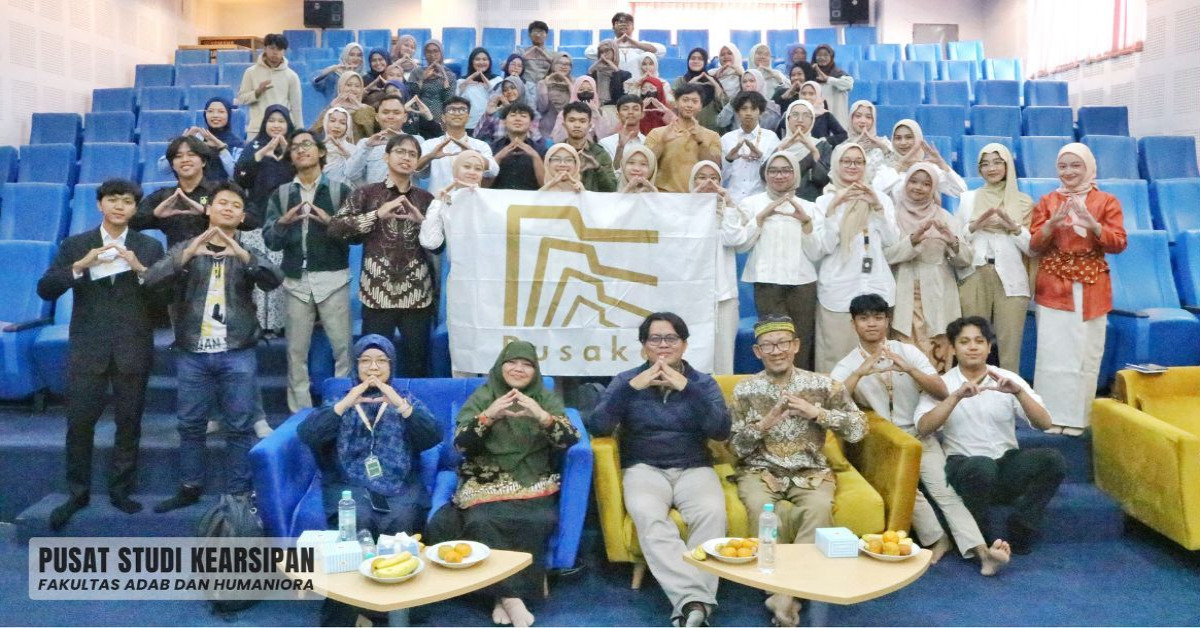
As a closing remark and introduction to the discussion, Diva expressed hope that the seminar would foster collective awareness among participants regarding the importance of preserving literary archives. For her, these manuscripts are intellectual heritage containing invaluable historical and cultural values, as well as a means for each generation to understand its national identity. The event continued with an interactive Q&A session and concluded with the presentation of souvenirs and a group photo.
Writers: Nadhira Sonja Isinbayeva, Zaskia Syahda Hafizha Kurniawan
Documentation: