
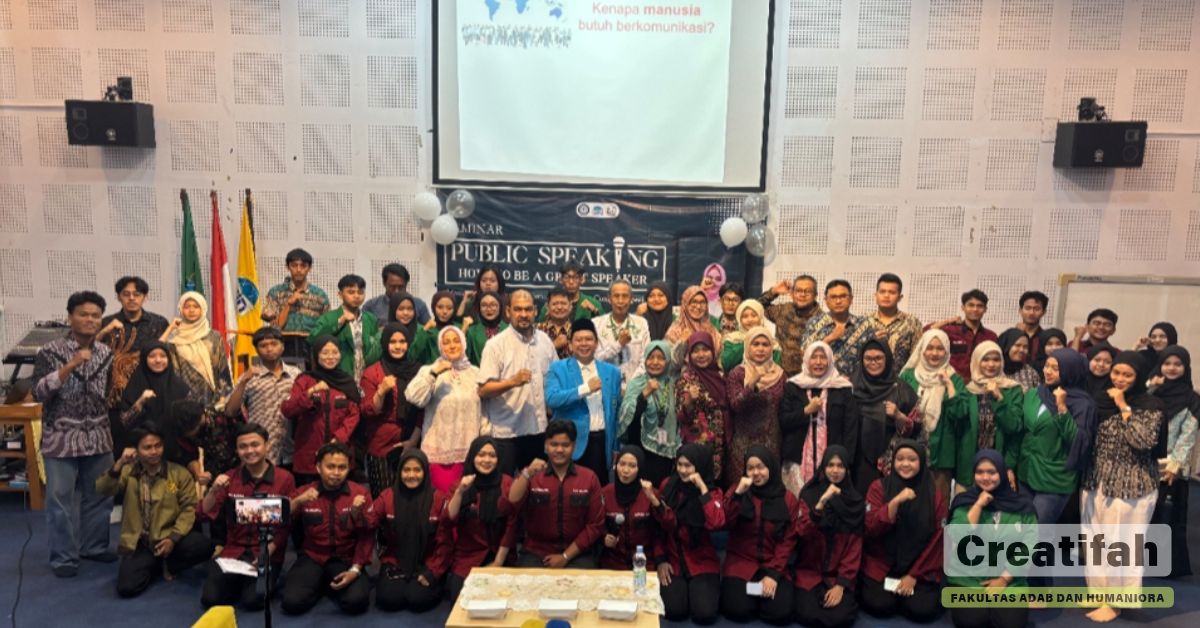
HMPS BSA UIN Jakarta Holds “Public Speaking: How to Be a Great Speaker” Seminar and Professional Master of Ceremony (MC) Training
CIPUTAT – The Student Association of the Arabic Language and Literature Study Program (HMPS BSA), Faculty of Adab and Humanities (FAH), Syarif Hidayatullah State Islamic University Jakarta, held a seminar and training program entitled “Public Speaking: How to Be a Great Speaker” on Wednesday, November 25, 2026. The hybrid event featured communication practitioner and trainer Dean Herdesviana, M.M., C.PS., CT., CMSE, as the keynote speaker.
The event took place offline at the Abdul Ghani Theater, Faculty of Adab and Humanities Building, UIN Jakarta, and was simultaneously accessible online via Zoom. It was also attended by Prof. Usep Abdul Matin, S.Ag., M.A., M.A., Ph.D., along with members of the academic community of the Faculty of Adab and Humanities.
Notably, the event was not limited to UIN Jakarta students but was also open to the general public. Participants came from diverse backgrounds, including students from various study programs and external participants seeking to improve their communication skills, confidence, and public speaking abilities.
Through this initiative, HMPS BSA UIN Jakarta aimed to provide a learning and personal development platform, particularly in public communication and professional Master of Ceremony (MC) skills.
Three Foundations of Becoming a Great Speaker: Dream, Link, and Action
In his presentation entitled “Becoming an Outstanding Speaker,” Dean Herdesviana explained that becoming an effective speaker is not an overnight achievement. It requires continuous learning, consistent practice, and personal development.
He introduced three essential foundations for becoming a great speaker: The Power of Dream, The Power of Link, and The Power of Action.
First, The Power of Dream emphasizes the importance of having aspirations and the courage to envision the future. Dean highlighted that every major achievement begins with a dream. However, dreams should not remain mere aspirations; they must be supported by careful planning, hard work, and consistency.
In this regard, he introduced the principle of “DUIT,” which stands for Doa (prayer), Usaha (effort), Ikhtiar (striving), and Tawakal (trust in God). This principle serves as a reminder of the importance of balancing aspirations, hard work, and faith throughout the journey toward achieving one's goals.
Second, The Power of Link highlights the importance of building meaningful relationships. According to Dean, establishing good connections with others is an important factor in creating new opportunities. A broad network can enrich knowledge, expand experience, and open opportunities for collaboration. Therefore, relationships should be nurtured through honest, respectful, and mutually appreciative communication.
Third, The Power of Action emphasizes the importance of taking concrete steps. Dean reminded participants that dreams and extensive networks cannot produce meaningful results without real action. In public speaking, understanding theories or observing other speakers is not enough. Speaking skills must be continuously developed through direct practice.
To reinforce this point, he referred to a well-known idea attributed to Confucius concerning the importance of practical experience in learning: what is heard is easily forgotten, what is seen is more easily remembered, and what is done is more easily understood.
Thus, becoming a great speaker is not merely about the ability to arrange words but also about having the courage to dream, build relationships, and take meaningful action.
Understanding the Fundamentals of Communication and Building Self-Confidence
In the following session, Dean discussed the fundamentals of communication, describing it as the process of conveying messages, ideas, and thoughts to others so that they can be understood according to the communicator's intended meaning.
He explained that communication serves several important functions in everyday life and professional environments. These include expressing intentions to achieve goals, resolving problems, building interpersonal relationships, and preventing misunderstandings that may lead to conflict.
In practice, communication is divided into two main forms: verbal and nonverbal communication. Verbal communication involves the use of words, either spoken or written. Meanwhile, nonverbal communication is conveyed through body language, facial expressions, hand gestures, and other visual cues.
Dean also explained the distinction between interpersonal communication, which involves direct interaction between individuals, and public communication, which is directed toward a wider audience through various forms of media.
Public speaking, in particular, serves three main purposes: informing audiences, entertaining them, and influencing listeners to accept an idea or take a particular course of action.
Mastering this skill offers various benefits, including improving audience understanding, reducing psychological pressure when speaking in public, strengthening social relationships, and helping individuals identify and resolve problems.
Beyond theoretical explanations, Dean also shared several strategies for overcoming nervousness and stage fright, which are commonly experienced by individuals when speaking in front of an audience.
The five strategies include letting go of regrets over previous shortcomings, developing a more positive self-perception, not being afraid of failure, preparing thoroughly, and recalling past achievements as a source of motivation and self-confidence.
Through these steps, participants were encouraged to understand that self-confidence does not emerge automatically. Rather, it must be developed through mental readiness, thorough preparation, and practical experience.
Mastering the Skills of a Professional Master of Ceremony
In addition to public speaking, the seminar also placed special emphasis on the skills required to become a professional Master of Ceremony (MC).
Dean explained that an MC plays an essential role in managing and directing an event to ensure that it runs smoothly, systematically, and according to the schedule or rundown prepared by the organizing committee.
An MC is not only expected to possess good speaking skills but must also understand audience characteristics, master the event sequence, and adapt to various situations that may arise during the event.
Preparation is one of the main factors determining an MC's success. This includes understanding the event rundown, becoming familiar with the audience profile, and knowing the objectives of the event.
Furthermore, an MC must be capable of managing time, maintaining a conducive atmosphere, engaging the audience, and using polite and professional language.
During his presentation, Dean outlined six essential steps for opening an event:
-
Delivering an opening greeting.
-
Acknowledging and respectfully addressing invited guests and attendees according to the appropriate protocol.
-
Briefly introducing oneself, when necessary.
-
Expressing appreciation to the organizers and participants.
-
Explaining the purpose and objectives of the event.
-
Providing an overview of the event agenda.
In addition to understanding the opening sequence, an MC must also master vocal techniques and body language. Vocal skills such as intonation, speaking pace, volume, and articulation are essential for delivering messages clearly and engagingly.
Meanwhile, effective body language can be demonstrated through an upright posture, friendly facial expressions, natural hand gestures, and evenly distributed eye contact with the audience.
Dean also reminded participants to avoid common mistakes made by MCs, including excessive body movements, insufficient eye contact, poor posture, unprofessional behavior, language that does not suit the nature of the event, and ineffective time management.
The Importance of a Memorable Closing in Public Speaking
At the end of the session, Dean emphasized the importance of an effective closing technique in presentations and events hosted by an MC.
According to him, the closing plays a significant role in reinforcing the messages delivered so that they remain memorable to the audience even after the event has ended.
Several techniques can be used to create an engaging and memorable closing. These include summarizing the key points, delivering an inspiring quotation, offering motivation and a call to action, incorporating relevant humor, reiterating the practical benefits of the material, and inviting the audience to enthusiastically repeat an inspirational slogan together.
With the right closing techniques, a speaker can not only conclude a presentation in a structured manner but also leave a positive impression and encourage the audience to put the messages they have received into practice.
Encouraging Students to Become More Confident and Competent Communicators
Through the seminar and training program “Public Speaking: How to Be a Great Speaker,” HMPS BSA of the Faculty of Adab and Humanities, Syarif Hidayatullah State Islamic University Jakarta, hopes that participants will gain a more comprehensive understanding of public communication and event-hosting skills.
The event also serves as a platform for personal development, enabling students and members of the general public to strengthen their self-confidence, expand their networks, and develop effective speaking skills across various settings.
Beyond understanding theoretical concepts, participants are expected to apply the knowledge they have gained through practical experience, whether in academic activities, student organizations, or community life.
Ultimately, becoming an effective speaker and a professional MC requires more than fluency in speaking. It also demands preparation, strong character, the ability to build relationships, and the willingness to continue learning and practicing.
Written by: Muhammad Afiq Izzan Budiawan