
Fasting, Knowledge and Wisdom – Reflections on Ramadan from a Prophetic Librarian Perspective
Dr. Ade Abdul Hak, S.Ag., S.S., M.Hum., CIQnR
Ramadan always presents a momentum for reflection for Muslims. Every year we are invited to fast, refrain from eating and drinking, but also subdue our desires and increase our worship. In the midst of the fast-paced development of technology and information, we often forget that Ramadan is a space to refresh our relationship with the Koran, with knowledge and with wisdom. This article invites readers to explore the series of verses on the command to fast (QS Al‑Baqarah 2:183–187) with the lens of prophetic librarianship— a paradigm that sees libraries as extensions of revelation and librarians as guardians of wisdom.
Starting Ramadan with Consciousness
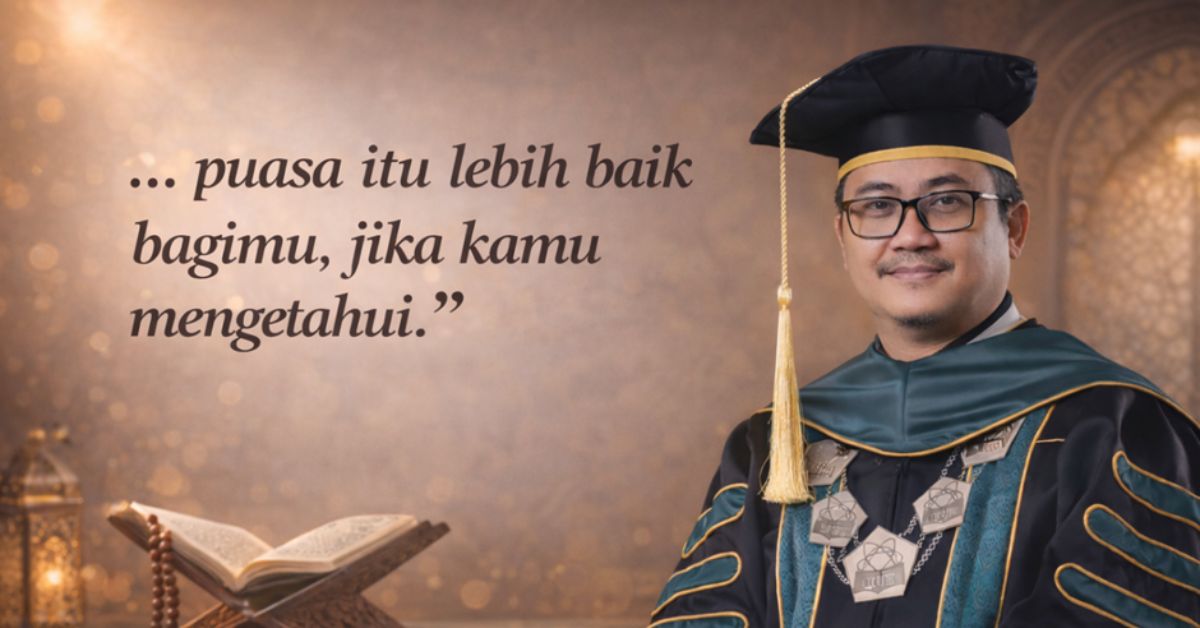
Verse 184 of Surah Al‑Baqarah reminds us that fasting is a few days appointed by Allah. After providing relief for those who are sick or traveling, this verse closes with the phrase “... fasting is better for you, if you know”. This phrase is not just a rhetorical conclusion; he invites us to understand why fasting. Fasting is not to torture ourselves, but to foster patience, social sensitivity, and awareness that the blessings we feel every day come from Allah.
In the perspective of prophetic librarianship, this awareness is in line with the librarian's task: to open access and educate the public to understand the value of knowledge. In libraries, books and data are not meaningless piles; it brings messages, wisdom, past experiences. Likewise fasting: not only endures hunger, but sharpens awareness of the meaning of life.
Gratitude for Guidance and Knowledge
The next verse, 2:185, confirms that Ramadan is the month in which the Qur'an was revealed as a guide for humans. This verse closes with “so that you are grateful”. Gratitude here is not just a thank God; it means making good use of blessings. Tafsir Abul Ala Maududi emphasizes that fasting is an expression of gratitude for the gift of the Qur'an, and the way to be grateful is to prepare oneself to practice the message of the holy book.
Gratitude in the world of libraries is realized by caring for sources of knowledge and respecting copyright. We enjoy various readings—Al‑Qur'an, books, journals—because there are writers and librarians who maintain this heritage. By reading more during Ramadan, we fill gratitude with knowledge. Every time we open a mushaf or book, we seem to connect a long chain of wisdom from generation to generation.
From Prayer to Maturity
Verse 2:186 places prayer as an important part of the fasting sequence. Allah confirms “I am close. I answer the prayers of those who pray to Me...”, then close with “so that they may be in the truth”. The Arabic phrase, la'allahum yarshudūn, describes humans who attain rushd: moral and spiritual maturity, capable of making the right decisions.
In the information world, librarians play the role of guides: helping readers sort out valid sources and preventing them from getting lost by hoaxes. Likewise, fasting trains us to filter unnecessary urges and focus on things that bring us closer to Allah. Prayer not only asks for worldly needs, but is a means of forming wise, mature and truth-oriented character.
Maintaining Boundaries and Achieving Piety
Verse 187 is a conclusion full of wisdom. After explaining the etiquette of fasting—when it is permissible to eat, how husband and wife are related at night, and the prohibition on approaching the mosque when I'tikaf‑Allah says: — That is the limit (hudūd) of Allah, so do not approach it... so that they become pious“. Staying away from Allah's prohibitions is not just blind obedience; Ibn Kathir explained that the explanation of this limitation aims to ensure that humans receive the right guidance. By obeying limits, we train ourselves to be careful, cultivating piety, namely the continuous awareness that God watches over every action.
In libraries, there is a code of conduct: librarians safeguard user privacy, reject plagiarism, and safeguard access rights. There are limits that must not be violated—for example destroying books or stealing data. Obeying these limits fosters trust. Likewise, fasting teaches us to refrain from halal things at certain times in order to be able to abandon what is haram at all times.
Bridging Tradition and Technology
The prophetic librarian view originates from the idea of integrating revelation and science. Kuntowijoyo in the concept of Prophetic Social Sciences proposes three pillars: humanization, liberation and transcendence. Humanization places humans as noble creatures; liberation frees from oppression and ignorance; transcendence links knowledge to faith. These three pillars are reflected in the fasting verses: knowing (humanization, because consciousness changes behavior), gratitude (liberation from egoism), rushd (liberating maturity), and piety (transcendence).
In the digital era, the role of librarians is becoming increasingly strategic. The article by the Faculty of Adab UIN Jakarta highlights the thoughts of Said Nursi, who describes Imam Mubin as a metaphysical archive that records every event. Nursi assesses prophetic librarians as data guardians and moral interpreters amidst the flow of big data and AI; they ensure that the information accessed by the public is accurate and ethical. By making wise use of technology, we can expand religious literacy without sacrificing spiritual value.
Personal Reflection
When fasting, I often feel like time is running slow. The hunger before the evening call to prayer made me count the minutes, realizing how hard life was for those who were deprived. After breaking the fast, a sip of water feels like a great gift. This simple experience teaches that knowledge is not just a concept in the book, but a life experience that shapes wisdom. Fasting makes us sensitive to small blessings and realize how fragile we are without God's help.
While sitting in the campus library, I reflected on the relationship between books and fasting. There, thousands of titles are neatly arranged, waiting to be read. Many students pass through shelves without turning their heads, just as many people pass through the fasting verses without understanding their meaning. Prophetic librarianship reminds me that every book, every verse, has the potential to free us from ignorance. Our job is to open and read it with an open heart.
Conclusion: Interpreting Ramadan with Knowledge and Action
Fasting, knowledge, and wisdom are three interconnected keywords. Fasting builds discipline and sensitivity; knowledge provides correct understanding; wisdom is born when the two unite. In the perspective of prophetic librarianship, the series of fasting verses are not only rules of worship but curricula of human formation: knowing, being grateful, achieving rushd, and finally being devout. In the digital era, we have a great opportunity to increase religious literacy by utilizing physical and digital libraries, but also the challenge of maintaining ethical use of information.
Towards the end of Ramadan, let's think about it: has this year's fasting fostered our knowledge and wisdom? Have we been grateful for Divine guidance by adding reading and understanding verses? And have we maintained the boundaries that God has set, both in the real world and digital space? May this fast bring us closer to the level of knowledgeable and wise humans— in accordance with the hopes of the Qur'an and the mandate of the prophetic librarian profession. Wallahu'alam canawab.