
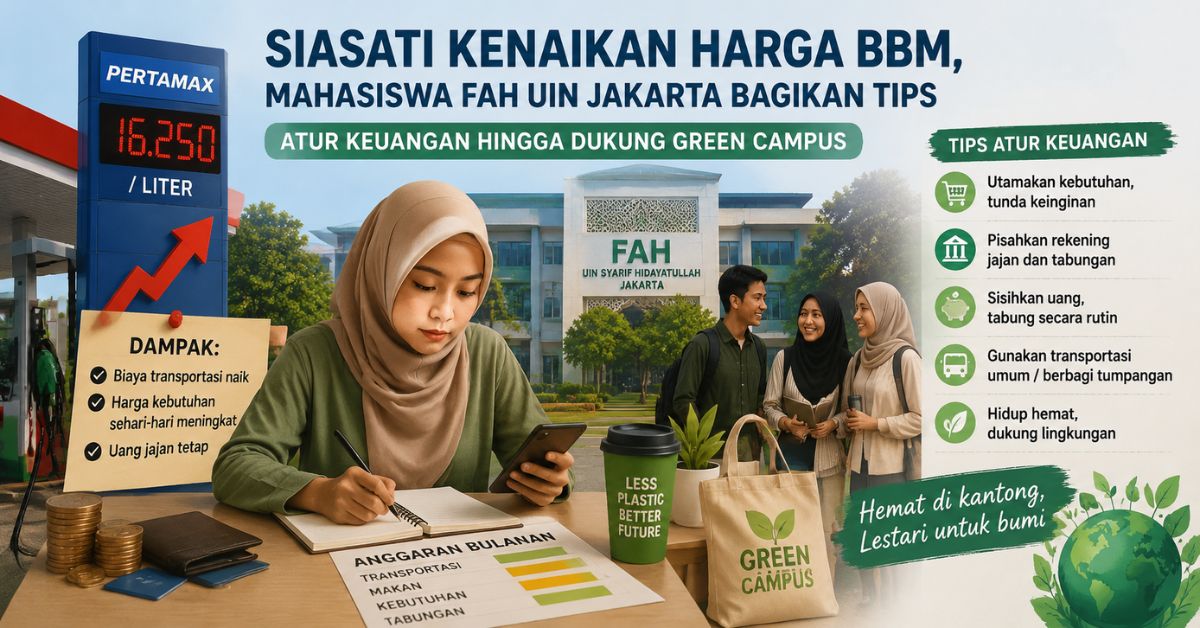
Dealing with the Increase in Fuel Prices, FAH UIN Jakarta Students Share Financial Management Tips and Support the Green Campus Initiative
The increase in fuel prices, particularly Pertamax which has now reached IDR 16,250 per liter, has once again become a public concern due to its widespread impact on transportation costs, daily necessities, and consumption patterns in society. This condition is also felt by students in the Faculty of Adab and Humanities (FAH), Syarif Hidayatullah State Islamic University Jakarta, who have begun adjusting the way they manage their finances in order to remain stable amid economic pressure.
To understand this impact, interviews were conducted with several FAH students regarding their strategies in facing the rising cost of living. The results show that the increase in fuel prices does not only affect financial aspects, but also encourages changes in consumption behavior and environmental awareness among students.
Direct Impact: Adjustment of Allowances and Living Costs
Most students reported that they did not experience an increase in their allowances from parents, while transportation costs and daily needs have increased. This condition forces them to be more selective in managing their monthly expenses.
On the other hand, some students received additional allowances to offset the rising cost of living. However, this additional support is still considered insufficient to fully cover the increase in expenses, particularly transportation costs and personal needs such as self-care.
This phenomenon aligns with reports from various national media stating that the increase in energy prices, including fuel, has a domino effect on transportation inflation and daily consumer goods (Kompas: Impact of Fuel Price Increases on Inflation).
Student Perspective: From Economic Burden to Environmental Awareness
Interestingly, some students do not only view the increase in fuel prices as an economic burden, but also as a moment of reflection on consumption patterns in society. One emerging perspective is that rising prices of goods, including skincare products, can encourage a reduction in the use of single-use plastics.
This view is in line with the green campus concept promoted at UIN Jakarta, including FAH, which aims to build environmental awareness in daily life. Thus, economic pressure can become a catalyst for more environmentally friendly behavioral change.
Several environmental studies also show that changes in consumption behavior can occur when prices reflect environmental impacts, including reducing plastic waste and excessive consumption (Tempo: Eco-Friendly Lifestyles Among Young People).
Student Strategies: More Disciplined Financial Management
In response to this situation, FAH students have implemented various simple but effective financial strategies. One of them is postponing non-urgent purchases and developing the habit of saving from remaining allowances.
Another common strategy is separating accounts for daily needs and savings. In this way, students can control their spending more strictly. For example, from an allowance of IDR 150,000, a portion is directly allocated to savings before being used for daily needs.
This approach is in line with basic financial literacy principles recommended by the Financial Services Authority (OJK), namely “allocating income into needs, wants, and savings/investments” (OJK: Financial Literacy Indonesia).
Solutions and Recommendations for Students
In addition to individual strategies, there are several solutions that can be applied by students to face economic pressure due to rising fuel prices:
- Improving financial literacy from an early stage
Students need to understand basic financial management such as expense tracking, monthly budgeting, and controlling impulsive spending. - Optimizing shared transportation (carpooling and public transport)
Using public transportation or ride-sharing can reduce daily expenses while also lowering carbon emissions. - Utilizing financial management technology
Applications such as digital wallets and budgeting apps can help students monitor their cash flow more transparently. - Adopting a minimalist lifestyle (frugal living)
Students can prioritize essential needs and reduce unnecessary consumptive spending. - Role of universities in financial education
Universities can hold financial literacy seminars or student financial management workshops to increase collective financial awareness.
According to Bank Indonesia, improving financial literacy can strengthen individual economic resilience in facing price fluctuations and inflation (Bank Indonesia: Financial Education).
The increase in fuel prices not only affects economic conditions but also drives behavioral changes among students. FAH UIN Jakarta students demonstrate adaptability through more disciplined financial management, environmental awareness, and more structured frugal living strategies.
More broadly, this situation also highlights an important lesson that financial literacy and environmental awareness are interconnected elements in shaping a resilient, wise, and sustainable generation of students.
Author: Nadhira Sonja Isinbayeva